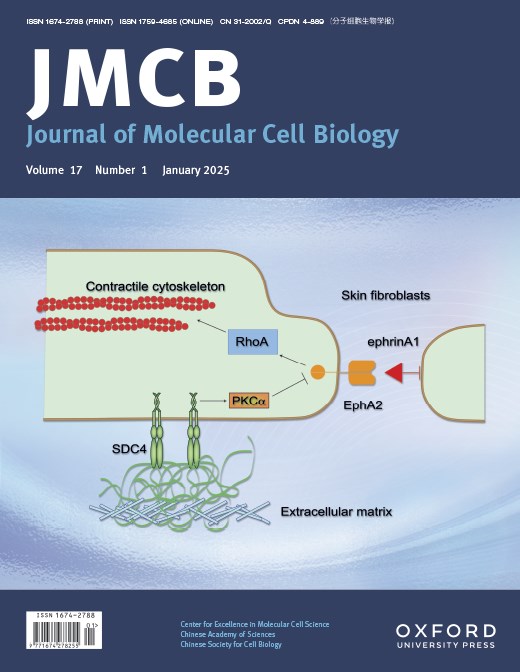
Upon injury, fibroblasts in the surrounding tissue become activated, migrating into the wound in a controlled manner. Once they arrive, they contract the wound and remodel the stroma. While certain cell surface receptors promote fibroblast migration, others cause repulsion between fibroblasts upon contact, seemingly opposing their clustering within the wound bed. Eph receptor–ephrin interactions on colliding cells trigger this repulsion, but how fibroblasts transition to clustering behaviour during healing remains unclear. Syndecan-4 modulates transmembrane receptors involved in wound healing, including receptors for the extracellular matrix and growth factors. As a result, Sdc4–/– mice experience delayed healing due to impaired fibroblast recruitment. In this study, we report that syndecan-4 also regulates fibroblast repulsion during wound healing. We discover that syndecan-4 inhibits the expression and signalling of EphA2 by activating PKCα. Changes in syndecan-4 expression, such as those observed during wound healing, alter fibroblast behaviour from repulsion to adhesion upon cell collision by modulating EphA2 levels. Moreover, we find that EphA2 expression is suppressed in wound bed fibroblasts in a syndecan-4-dependent manner, explaining how fibroblast clustering is achieved during wound healing.